What happens when you ask a 2026 coding agent like Claude Code to build a chess engine from scratch (with no plan, no architecture document, no step-by-step guidance) in a language that was never designed for this purpose? Building a chess engine is a non-trivial software engineering challenge: it involves board representation, move generation with dozens of special rules (castling, en passant, promotion), recursive tree search with pruning, evaluation heuristics, as well as a way to assess engine correctness and performance, including Elo rating. Doing it from scratch, with minimal human guidance, is a serious test of what coding agents can do today. Doing it in LaTeX’s macro language, which has no arrays, no functions with return values, no convenient local variables or stack frames, and no built-in support for complex data structures or algorithms? More than that, as far as I can tell, it has never been done before (I could not find any existing TeX chess engine on CTAN, GitHub, or TeX.SE). Yet, the coding agent built a functional chess engine in pure TeX that runs on pdflatex and reaches around 1280 Elo (the level of a casual tournament player). This post dives deep into how this engine, called TeXCCChess, works, the TeX-specific challenges encountered during development. You can play against it in Overleaf (see demo https://youtu.be/ngHMozcyfeY) or your local TeX installation https://youtu.be/Tg4r_bu0ANY, while the source code is available on GitHub https://github.com/acherm/agentic-chessengine-latex-TeXCCChess/

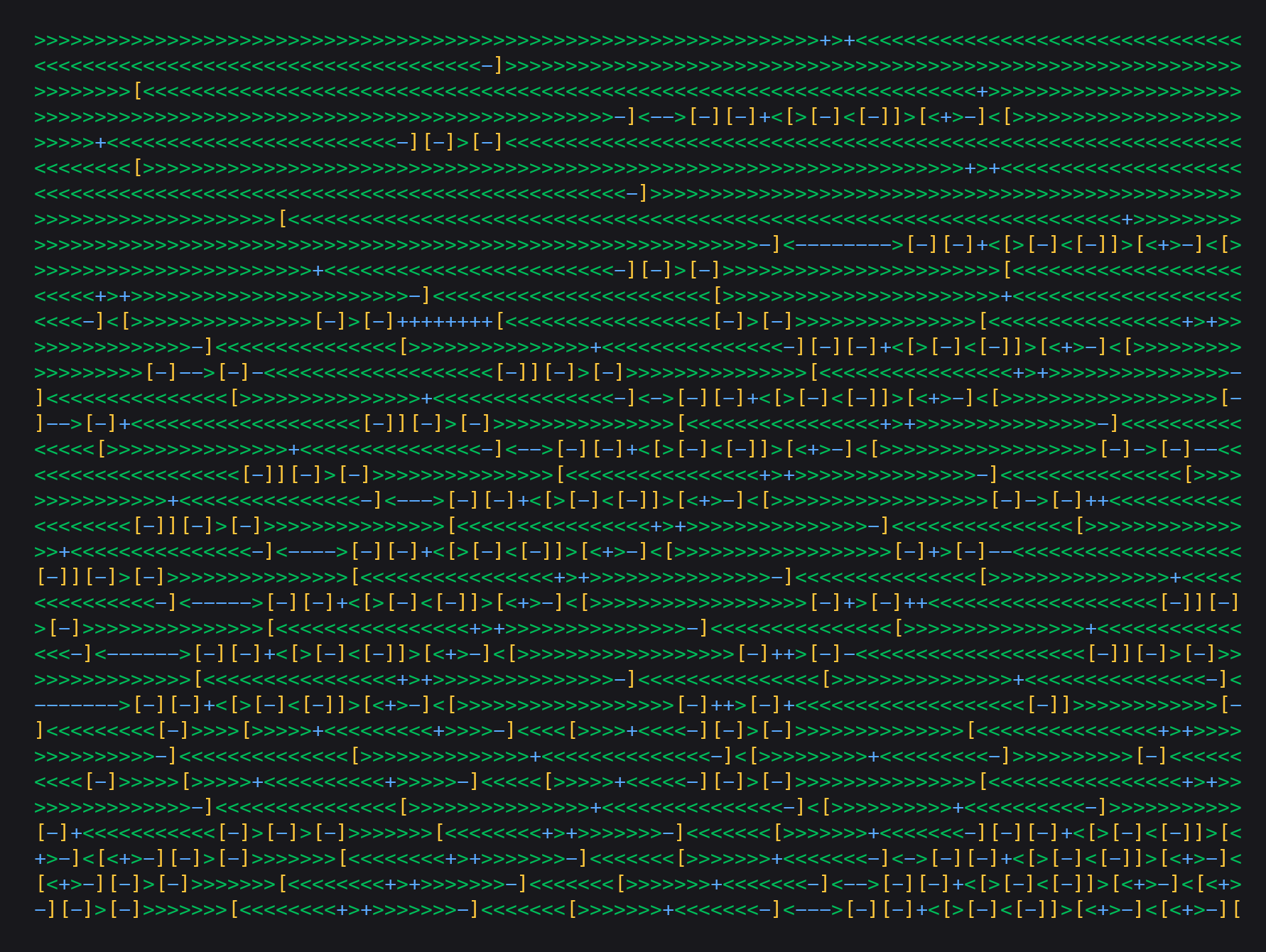 It implements depth-3 minimax search with alpha-beta pruning, full move generation (including castling, en passant, and promotion), and MVV-LVA evaluation with positional bonuses. It passes 11/11 perft validation positions. It is not strong: it beats random moves convincingly but loses every game against Stockfish at minimum settings. Each move takes between 45 seconds and 10 minutes to compute. The project shows that coding agents can operate in Brainfuck at a scale never achieved before for a chess engine, not through raw translation but by designing intermediate abstractions (a pointer-tracking emitter, a memory layout manager, runtime loop patterns) that make the task tractable. Yet despite a non-trivial implementation of search, evaluation, and special moves, the resulting engine is only capable of beating a random move generator, with a large gap to even the weakest conventional engines. Closing that gap, through human-AI co-design iteration, is an open and exciting direction.
 I tried it with
 The tldr; is that